
Manufacturers do not have a shortage of data.
They have a shortage of connected operational context.
The MES knows the order. The historian knows the temperature. The CMMS knows the maintenance intervention. The QMS knows the defect. The SOP describes the approved procedure. An engineer knows which exception matters. An operator remembers what changed two shifts ago.
Every source can be correct while the organization still lacks one coherent picture of what is actually happening.
That is the problem a Living Manufacturing Model is meant to solve.
A living manufacturing model is not another data repository. It is a continuously updated operational context where people and AI agents work from the same understanding of assets, processes, evidence, decisions and outcomes.
Industrial companies have spent years connecting machines, deploying historians, modernizing ERP and MES estates, building data platforms, instrumenting processes, and adding sensors.
Yet the majority of industrial data still fails to become operational intelligence.
The World Economic Forum's August 2026 report on intelligent industrial ecosystems estimates that around 80% of industrial data in the European Union remains unused, limiting competitiveness, resilience and sustainability. Source: World Economic Forum, Intelligent Industrial Ecosystems
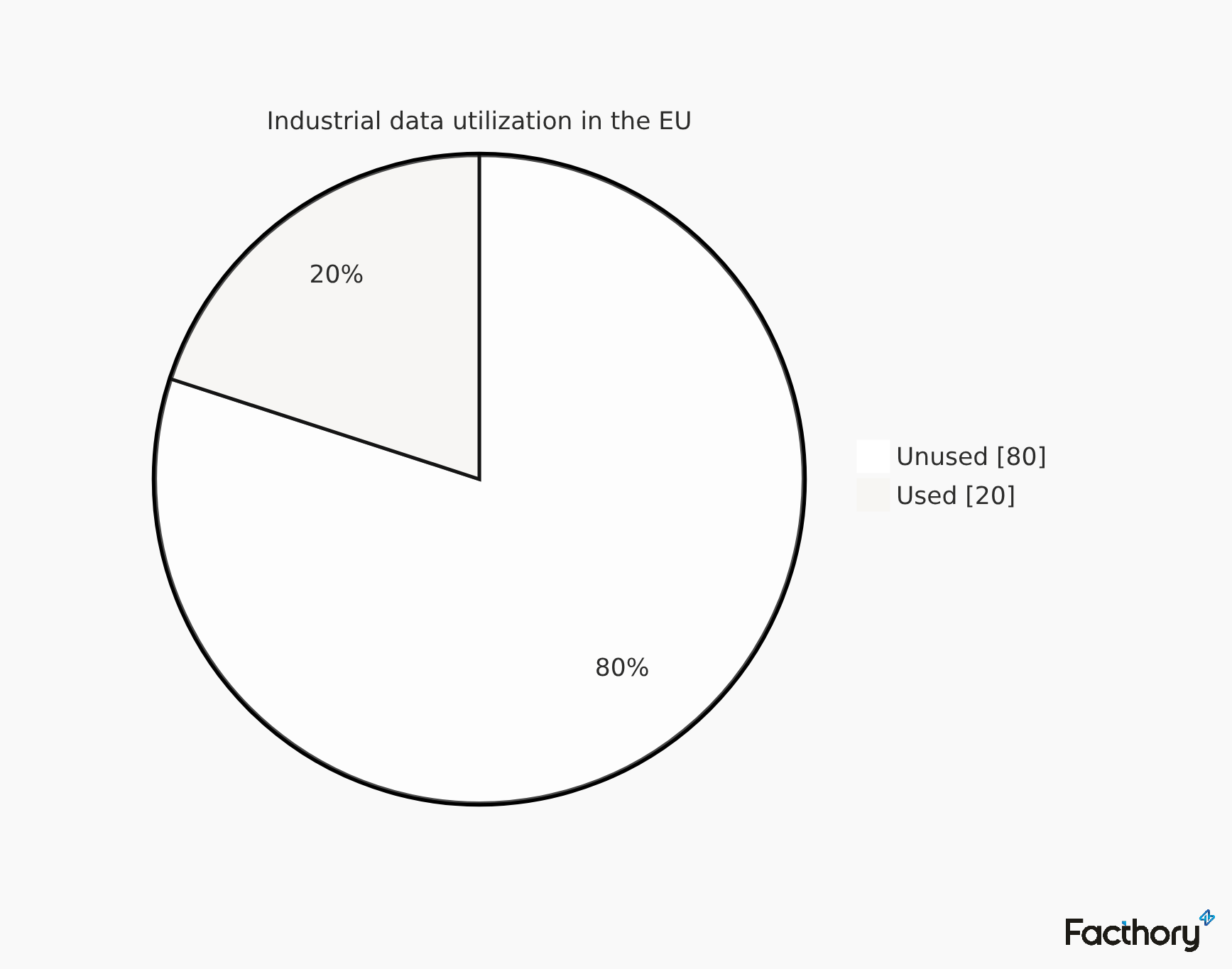
Unused does not necessarily mean uncollected or inaccessible.
Often the missing piece is context.
A pressure reading is useful only when it is connected to the correct asset, product, process stage and point in time. A maintenance note becomes more valuable when it is linked to the failure that followed it. A quality incident becomes more useful when it can be compared with process conditions, supplier lots, equipment history and previous corrective actions.
The challenge is not moving everything into one database. It is preserving the relationships that make the information meaningful.
Manufacturing AI has moved beyond experimentation.
Deloitte's AI in Manufacturing 2026 survey of more than 140 manufacturers found that 84% already generate measurable value from AI. But only 20% of use cases are consistently scaled across sites or enterprise-wide. Deloitte identifies robust data foundations, governance and operating models as central requirements for moving from isolated pilots to industrialized AI. Source: Deloitte, AI in Manufacturing 2026
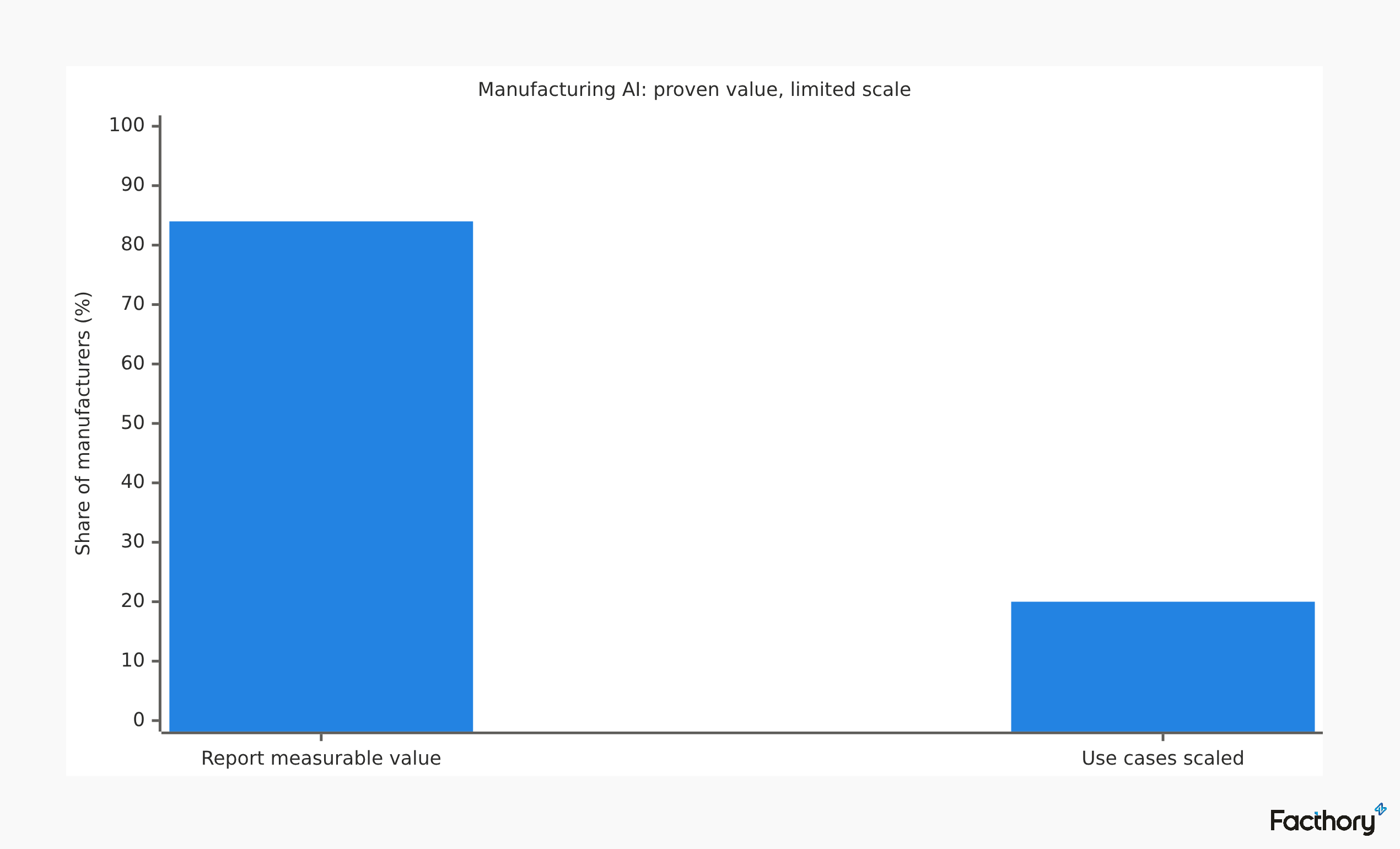
This gap is easy to understand.
A predictive model may work well on one line because the data, asset naming, maintenance conventions and local process knowledge are understood by the team that built it. Moving the same capability to ten plants can require rebuilding that context ten times.
If every AI use case has to rediscover the organization before it can create value, scaling becomes another integration project.
A living model changes that equation by making operational context reusable.
Digital twins are valuable because they create a structured representation of an asset, process or physical system.
But many important manufacturing decisions depend on a broader operating environment.
Why did the defect happen after the tool change? Which procedure applied at the time? Was the machine serviced differently at another site? Which engineer approved the deviation? Was the corrective action later validated? Which experienced technician knows the exception that never made it into the SOP?
Facthory's Living Operational Model connects that wider context:
assets, equipment and locations
products, batches and process stages
procedures, standards and engineering changes
maintenance, quality and production history
documents, images, video and voice
people, expertise and responsibilities
incidents, hypotheses, decisions and approvals
outcomes and validated learning
Existing systems remain systems of record. Facthory does not need to replace the MES, ERP, QMS or CMMS to understand how their information relates.
The model sits across them, preserving the operational relationships required for people and agents to reason about the work.
A static graph of enterprise data is useful.
A living model is more valuable because it changes when the organization learns something.
This is where Facthory's multiplayer agentic workflow becomes fundamental.
Manufacturing problems are rarely solved by one person in one session. Quality, maintenance, engineering, production and suppliers may all contribute different evidence. Several hypotheses may need to be investigated simultaneously. Some work can be delegated to specialist agents. Consequential decisions still require the right human judgment and approval.
Facthory gives those participants one persistent problem space.
A maintenance agent can analyze intervention history while a quality agent compares defect patterns. A process engineer can add operating constraints. An operator can contribute video or explain what actually happened on the line. A reliability expert can reject a weak hypothesis. A manager can approve the corrective action.
Everyone, human or agent, is working from the same governed context.
And when the investigation ends, the result does not disappear into a chat transcript.
The validated root cause, rejected hypotheses, evidence, decision, corrective action and measured outcome become part of the model for the next investigation.
| Traditional data layer | Facthory Living Operational Model | |
|---|---|---|
| Primary purpose | Store and retrieve information | Support shared operational work |
| Context | Reconstructed per application or use case | Persistent across people, agents and workflows |
| Human knowledge | Mostly external to the data model | Connected with operational evidence |
| AI interaction | Separate assistants or models | Multiple specialist agents in shared context |
| Learning | Stored as new records | Validated outcomes strengthen future work |
The commercial value of connected industrial intelligence is visible in the world's most advanced factories.
In June 2026, the World Economic Forum highlighted a new group of Global Lighthouse sites demonstrating a shift toward end-to-end intelligence and human-machine collaboration. One particularly relevant example is Hitachi Vantara's Norman manufacturing site, where fragmented data and rising product complexity were limiting performance. After integrating inventory visibility and decision-making into a global digital platform, the site reduced inventory by 50% and shortened order-to-ship lead time by 77%. Source: World Economic Forum, Global Lighthouse Network, June 2026
The same cohort included Rockwell Automation's Singapore site, which faced more than 20,000 annual changeovers and dependence on tacit worker knowledge. Its broader digital and AI transformation increased units per person-hour by 43%, reduced defects by 35%, and shortened time-to-competency by 67%. Source: World Economic Forum
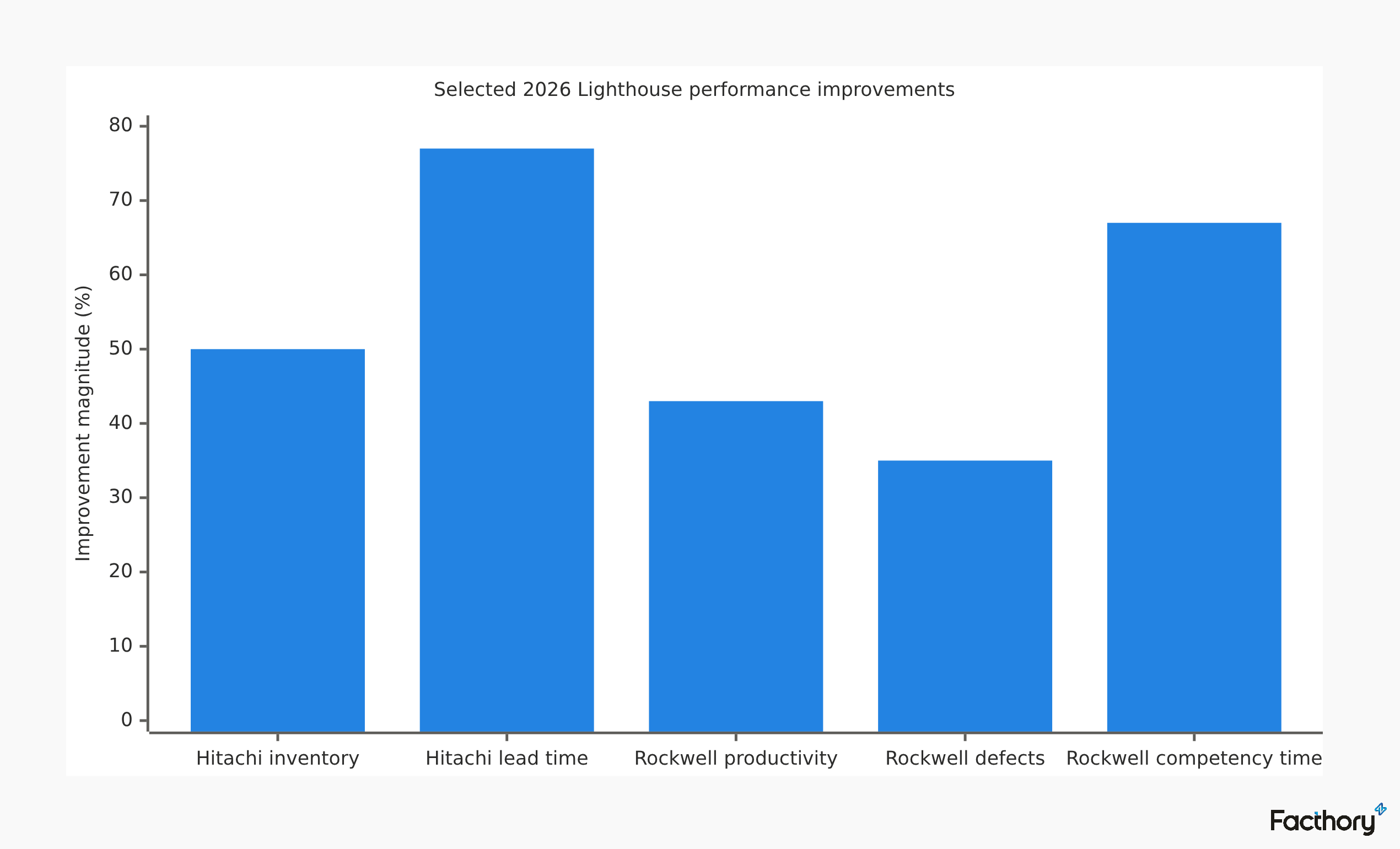
Chart note: bars show the magnitude of reported improvement. Hitachi figures are reductions in inventory and lead time. Rockwell figures are productivity improvement and reductions in defects and time-to-competency. These are WEF Lighthouse results, not Facthory customer benchmarks.
The important lesson is not that every manufacturer should copy one technology stack.
It is that the highest-value industrial transformations increasingly connect data, operational decision-making, workforce knowledge and AI into one operating system rather than optimizing isolated applications.
The biggest advantage appears over time.
Consider a recurring failure.
In a fragmented environment, the first team gathers evidence from several systems, finds the right people, tests hypotheses and eventually fixes the problem. Six months later, another site experiences something similar and repeats much of the same work.
In a living model, the first investigation leaves behind structured operational memory.
The second investigation can begin with the previous evidence, the approved root cause, the conditions under which it occurred, the corrective action, and the outcome that validated the fix.
The organization does not merely store more data. It accumulates operating intelligence.
This is also what makes the model valuable for AI agents. Better models will continue to become broadly available. What remains enterprise-specific is the understanding of how this company operates: its assets, processes, standards, exceptions, decisions, people and history.
Facthory is designed to make that context durable and multiplayer.
The result is a manufacturing environment where people and agents can investigate, coordinate and improve work together, while every validated outcome strengthens the context available to the next person and the next agent.
That is the shift from operational data to a Living Manufacturing Model.
