



Data processing: DPA and TOMs
Data processing agreement and technical and organisational measures
For data governance and compliance officers. This page holds the standard Data Processing Agreement under Art. 28 GDPR, the list of subprocessors, and the technical and organisational measures under Art. 32 GDPR. Questions go to dpa@facthory.com.
What this page covers
- Part A is the Data Processing Agreement (§§ 1 to 12) with the parties and Annex 2, the subprocessors. Part B is Annex 1, the technical and organisational measures (TOMs).
- Scope. The agreement covers FACTHORY in the Managed model (EU). For Bring your own cloud, private cloud and On-premises it applies only where Bandpey can access customer data, for example for support or maintenance.
- Every statement is a commitment. Each measure below describes the platform as it runs. Each source it relies on is linked.
Part A: Data Processing Agreement (Art. 28 GDPR)
This agreement is concluded between the following parties.
| Customer (controller) | Provider (processor) | |
|---|---|---|
| Name | [Company name] | Bandpey GmbH |
| Address | [Street and number, postcode, city, country] | Gmunder Str. 20b, 81379 Munich, Germany |
| Registration | Munich Local Court, HRB 285782 | |
| Date | [Date] |
Bandpey's standard agreement is shown here. The Customer enters its details in the placeholders. Questions and requests for a signed copy go to dpa@facthory.com.
§ 1 Subject, duration and scope
- The Provider processes personal data on behalf of the Customer when the Customer uses FACTHORY in the Managed model (EU) under the main agreement between the parties (the "Agreement").
- The agreement lasts as long as the Agreement.
- It covers FACTHORY in the Managed model (EU). For Bring your own cloud, private cloud and On-premises it applies only where Bandpey can access customer data, for example for support or maintenance.
- Terms such as "controller", "processor", "personal data" and "processing" have the meaning they have in Regulation (EU) 2016/679 (GDPR).
§ 2 Nature and purpose of the processing, data types and data subjects
Nature of the processing. Collecting, storing, organising, searching, analysing with AI models, transferring to subprocessors, and deleting.
Purpose. Operating FACTHORY for the Customer:
- documenting faults and solutions;
- knowledge management;
- documents (Page, Grid, Deck);
- analytics and dashboards;
- AI agents;
- the mobile app;
- support.
Types of personal data.
- user master data;
- usage and log data;
- user content: text, files, voice notes, videos and screen recordings;
- emails, where Microsoft 365 is connected.
Data subjects. The Customer's employees, and people named in content.
Special categories (Art. 9 GDPR). They are not processed without a separate agreement.
§ 3 Instructions
- The Provider processes personal data only on the Customer's documented instructions, including for transfers to a third country, unless Union or Member State law requires otherwise. In that case the Provider tells the Customer before the processing, unless the law forbids it (Art. 28(3)(a) GDPR).
- The Agreement, this agreement and the Customer's use and configuration of FACTHORY are the instructions. The settings of the product, such as access rights, retention rules and the writing mode of the agent, are the Customer's means of giving them.
- The Provider tells the Customer immediately if it believes an instruction infringes data protection law.
§ 4 Place of processing
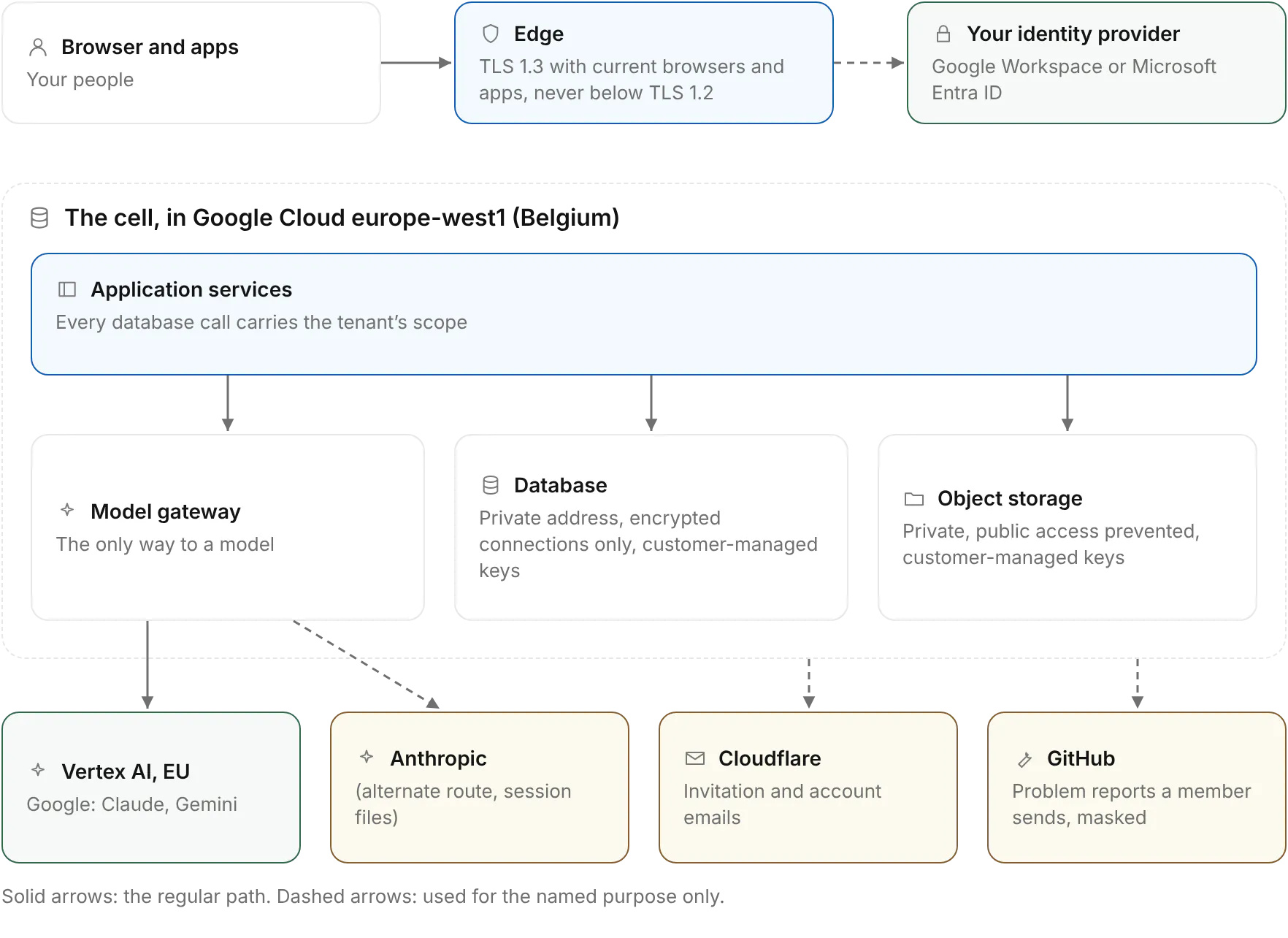
- The Provider processes in the EU first. FACTHORY is hosted on Google Cloud, primarily in the region
eu-1, which is europe-west1, Belgium. Requests to models go through Facthory's model gateway to Google Vertex AI in the EU (locationeu). Embeddings run in europe-west1, Belgium, with failover to europe-west4, the Netherlands. - Where a subprocessor processes personal data outside the EU/EEA, it does so only under the safeguards of Art. 44 ff. GDPR, in particular the EU standard contractual clauses. Annex 2 names each subprocessor and its safeguards.
- A change of a subprocessor or of a processing location follows § 6.
§ 5 Obligations of the Provider
- Confidentiality. Persons who process personal data are bound to confidentiality.
- Security. The Provider takes the measures of Annex 1 (Art. 32 GDPR) and keeps them up to date.
- Support access. Facthory staff reach the Customer's data only through a support grant that the Customer's owner or admin issues to a named person. The grant expires, the Customer can revoke it at any time, and the audit log records it.
- No training. Customer data is never used to train AI models, neither by Bandpey nor by any provider. Anthropic's Commercial Terms say that Anthropic may not train models on Customer Content from its services, and Google's terms for Vertex AI say that Google does not use customer data to train or fine-tune models without the customer's prior permission or instruction.
- Assistance. The Provider assists the Customer with data subject requests (§ 7), with the security of processing, with breach notifications, with data protection impact assessments and with consultations of supervisory authorities (Art. 32 to 36 GDPR).
- Evidence. The Provider makes the information available that shows its compliance with Art. 28 GDPR, and allows audits under § 9.
- Records. The Provider keeps the record of processing activities that Art. 30(2) GDPR requires.
- Contact. The data protection contact is dpa@facthory.com.
§ 6 Subprocessors
- The Customer generally authorises the Provider to use the subprocessors listed in Annex 2.
- The Provider announces an intended addition or replacement of a subprocessor at least 30 days in advance.
- The Customer may object on reasonable data protection grounds within that period. If the parties do not find a solution, the Customer may terminate the affected service.
- The Provider binds each subprocessor by contract to data protection obligations that match this agreement (Art. 28(4) GDPR) and stays liable to the Customer for them.
§ 7 Rights of data subjects
- The Provider forwards a request from a data subject that concerns the Customer's data to the Customer, and does not answer it on its own.
- The Provider assists the Customer with the means of the product. The Customer's owner sets retention rules per organisation, and the platform applies them every day.
- On the Customer's request, the Provider erases a single member, including the files of that member and the files that the member's sessions gave to the models.
§ 8 Personal data breaches
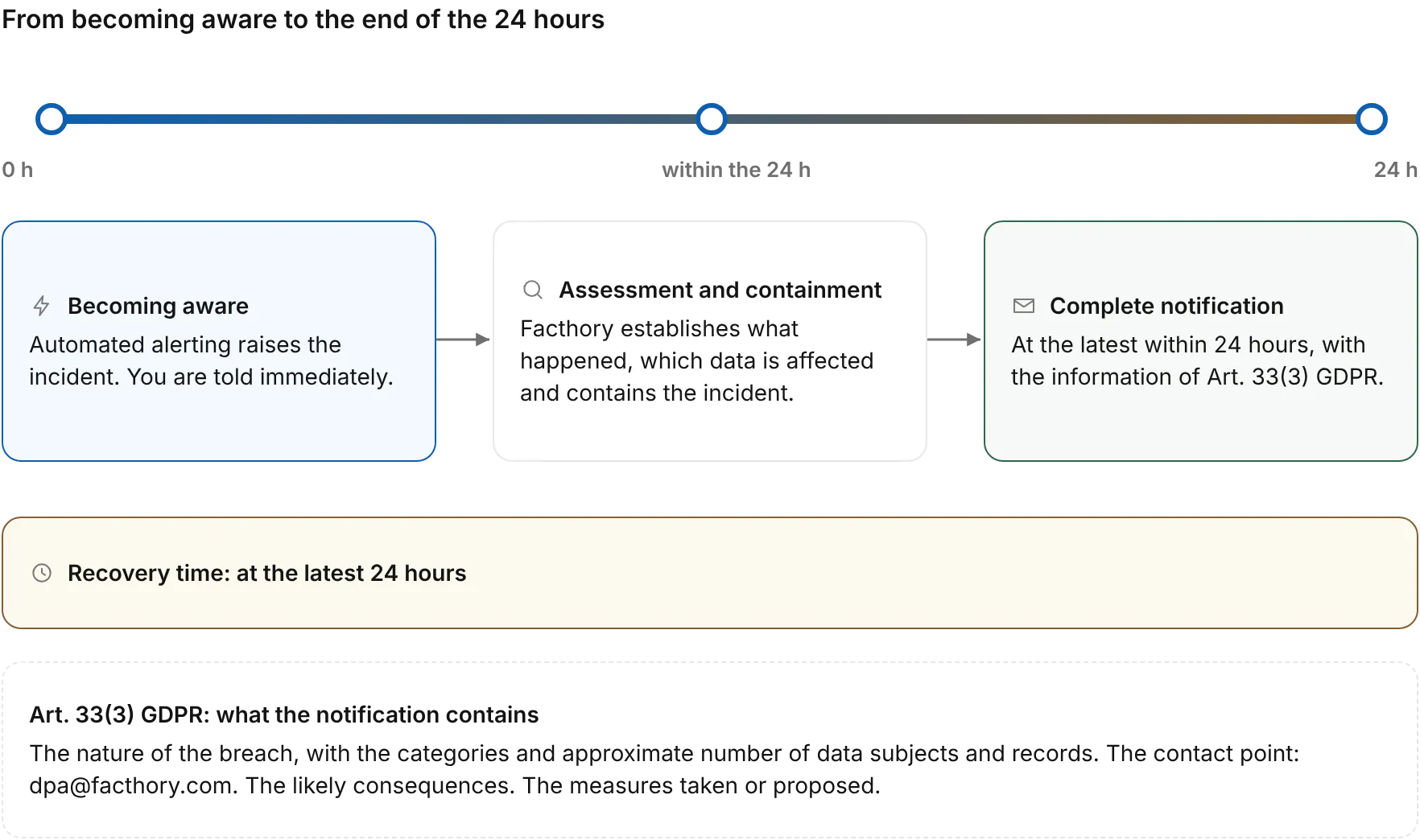
- The Provider notifies the Customer immediately on becoming aware of a breach of the security of personal data. Automated alerting raises the incident, and the notification is made at the latest within 24 hours.
- The notification contains the information of Art. 33(3) GDPR: the nature of the breach, with the categories and the approximate number of data subjects and records; the contact point, dpa@facthory.com; the likely consequences; and the measures taken or proposed.
- The recovery time after an incident is at the latest 24 hours.
§ 9 Audits
- The Customer may audit the Provider's compliance with this agreement.
- An on-site audit takes place at most once a year, with 14 days' notice. Where there is cause, such as a breach or a demand of a supervisory authority, the Customer may audit without these limits.
- The Provider supports the audit with documentation, with its records and with the independent reports that its subprocessors publish.
§ 10 Deletion and return
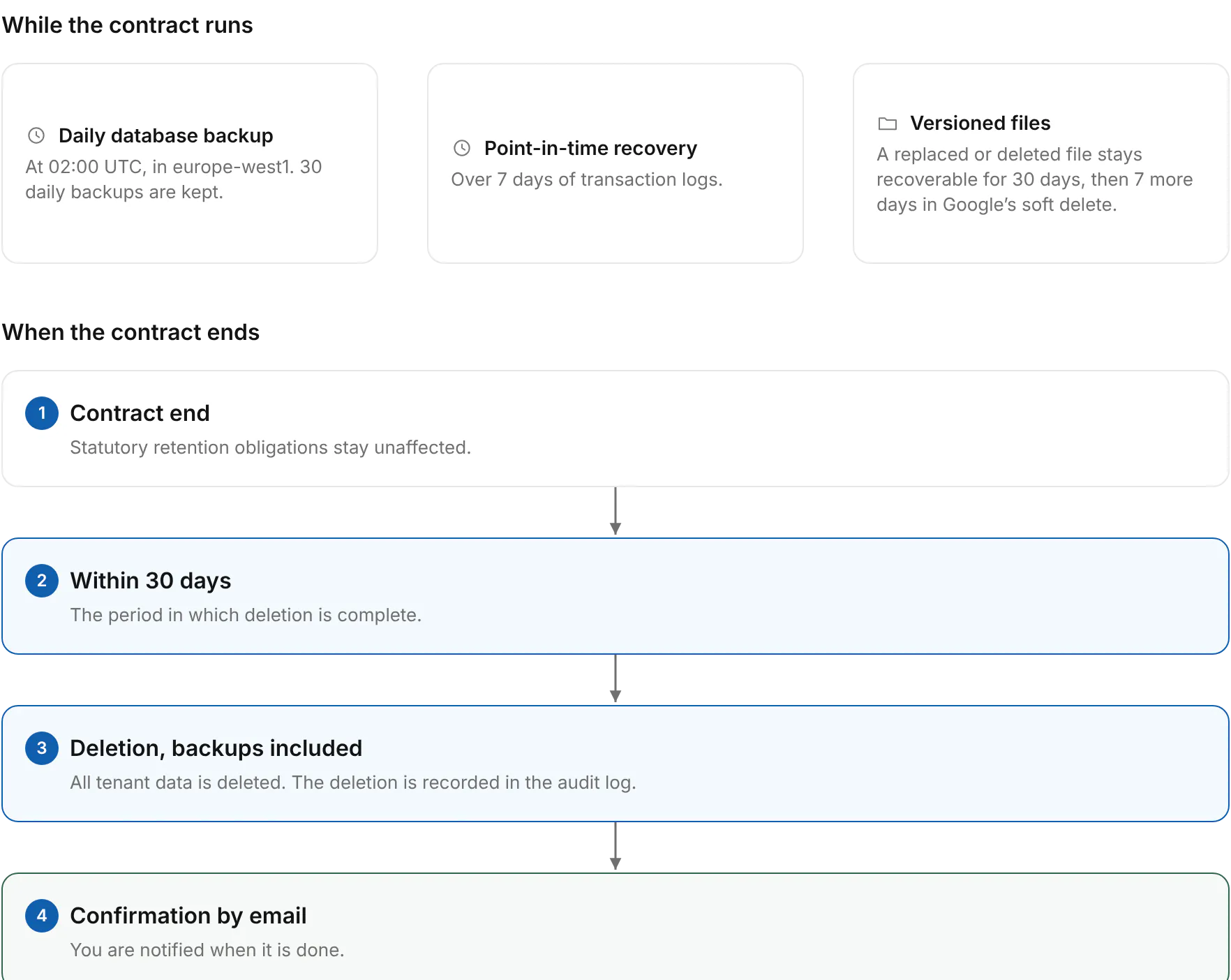
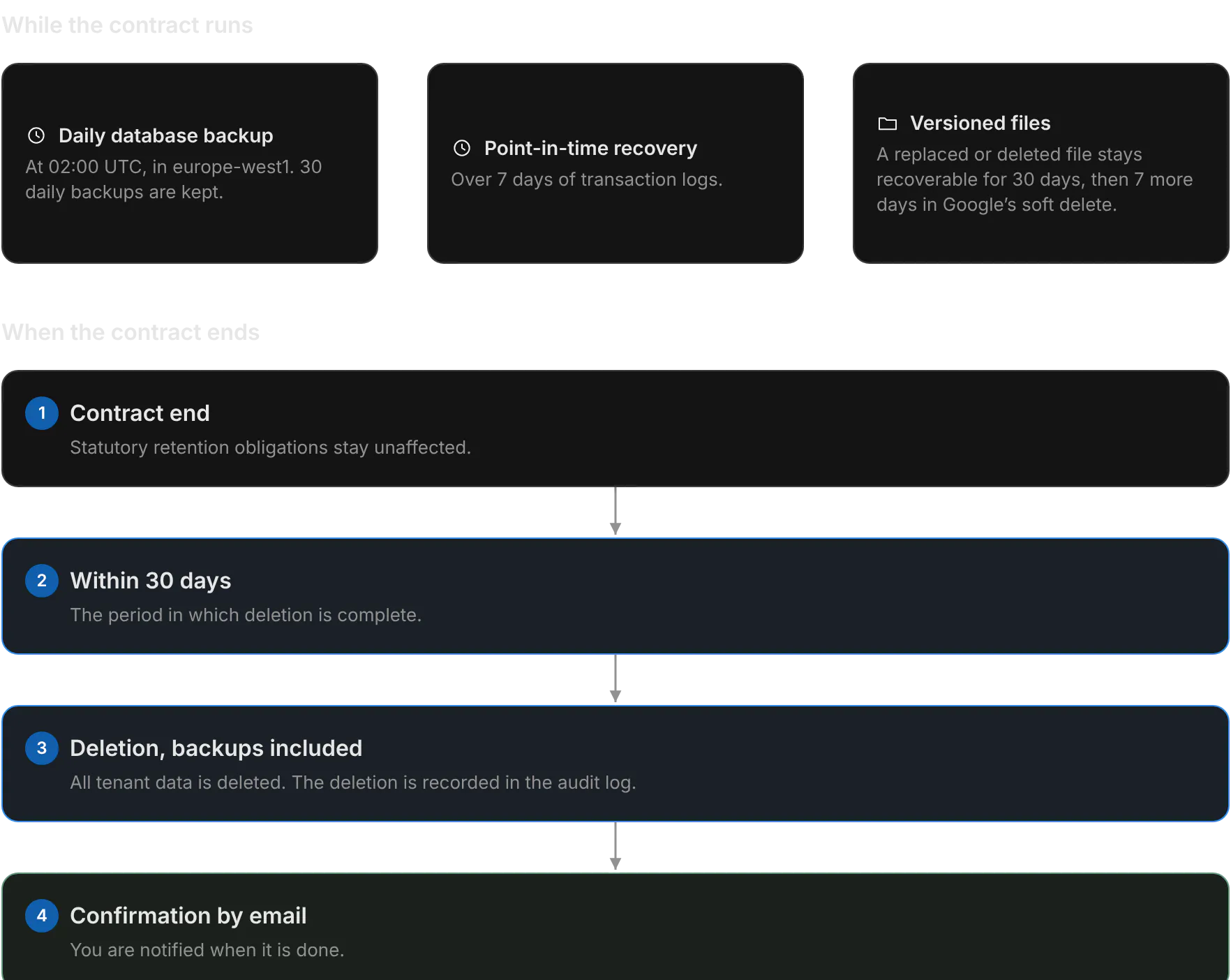
- After the contract ends, the Provider deletes the Customer's personal data within 30 days, backups included, and notifies the Customer by email. Statutory retention obligations stay unaffected.
- At the Customer's request before the end of the contract, the Provider returns the data in a format agreed with the Customer.
- While the contract runs, the platform keeps data for these periods: page versions for 30 days or up to 200 per page; records of sent emails for 30 days; notifications for at most 90 days; audit events for at least 90 days, and longer where the Customer's organisation sets a longer rule.
§ 11 Liability
- Liability towards data subjects follows Art. 82 GDPR.
- Between the parties, each party is liable in line with Art. 82 GDPR, including the right of recourse under Art. 82(5). Beyond that, the liability provisions of the Agreement apply.
§ 12 Final provisions
- German law applies. The place of jurisdiction is Munich, as far as the law allows.
- Changes and additions need text form. The same applies to a change of this clause.
- If the Agreement and this agreement differ on data protection, this agreement prevails.
- If a provision is invalid, the others remain valid.
- Annex 1 (technical and organisational measures) and Annex 2 (subprocessors) are part of this agreement.
Annex 2: Subprocessors
| Subprocessor and registered seat | Service | Data | Processing locations | Safeguards and source |
|---|---|---|---|---|
| Google Cloud EMEA Limited, 70 Sir John Rogerson's Quay, Dublin 2, Ireland | Hosting of the cell on Google Cloud; Vertex AI for chat, extraction, summaries, embeddings, speech and video; Google Maps Platform for place, geocoding and weather lookups that the agent makes | Customer content in the cell; content sent to models; lookup queries | EU (europe-west1, Belgium; Vertex AI EU) | Google Cloud Data Processing Addendum: processing in the EU, with the EU standard contractual clauses or an adequacy decision where a transfer applies. Contracting entity: Google Cloud entity page |
| Anthropic Ireland, Limited, 6th Floor, South Bank House, Barrow Street, Dublin 4, D04 TR29, Ireland | Claude models (alternate route); storage of files a member hands the agent in a session | The content of the request or of the file | Per Anthropic's published subprocessor list | EU standard contractual clauses under Anthropic's Data Processing Addendum |
| Cloudflare, Inc., 101 Townsend Street, San Francisco, CA 94107 | Cloudflare Email Sending from mail.facthory.com for invitation and account emails | Recipient address, name, message | Per Cloudflare's published subprocessor list | EU standard contractual clauses under Cloudflare's customer DPA |
| GitHub, Inc., 88 Colin P. Kelly Jr. St., San Francisco, CA 94107 | Problem reports that a member chooses to send, filed as issues through Facthory's reporting application | Ids, routes, statuses, builds, masked console lines, and the message the member types, capped and with addresses removed. A screenshot stays in the cell, and the issue only links to it. The member's text is removed from the issue when the cell deletes the report | Per GitHub's published subprocessor list | EU standard contractual clauses under GitHub's Data Protection Agreement |
Registered seats are as the subprocessors publish them: Google, Anthropic, Cloudflare and GitHub.
Gemini caching. Gemini models on Google Vertex AI may cache inputs and outputs in memory for up to 24 hours in the data centre that served the request. Google describes this on its data governance page.
Beside the list. Stripe processes billing data of the account. For billing data Bandpey acts as controller, so Stripe is not a subprocessor of customer content. Microsoft 365 is the customer's own service: a member connects their own mailbox and calendar, and Bandpey does not list it as its subprocessor.
On facthory.com only. Google Analytics and Microsoft Clarity run only on facthory.com, not in the platform. The privacy policy describes them.
Part B: Annex 1, Technical and organisational measures (Art. 32 GDPR)
The measures below protect confidentiality, integrity, availability and resilience of the processing, and they are reviewed regularly.
Confidentiality
Physical access. FACTHORY runs in Google Cloud data centres. Google designs and builds its own data centres with multiple layers of physical security and tightly controlled access (Google infrastructure security design overview). Google Cloud's information security management system is certified to ISO/IEC 27001, ISO/IEC 27017 and ISO/IEC 27018, and Google Cloud's controls are audited against SOC 2. Google's Compliance Resource Center lists the certificates and reports.
System access. People sign in only through the customer's own identity provider, Google Workspace or Microsoft Entra ID, using the OIDC authorization code flow with PKCE. The customer's multi-factor sign-in and lockout policies therefore apply. Facthory keeps only the SHA-256 hash of a session token, never the token. Services reach the database as IAM database users through the Cloud SQL Auth Proxy, so no database password exists. The database has a private address only.
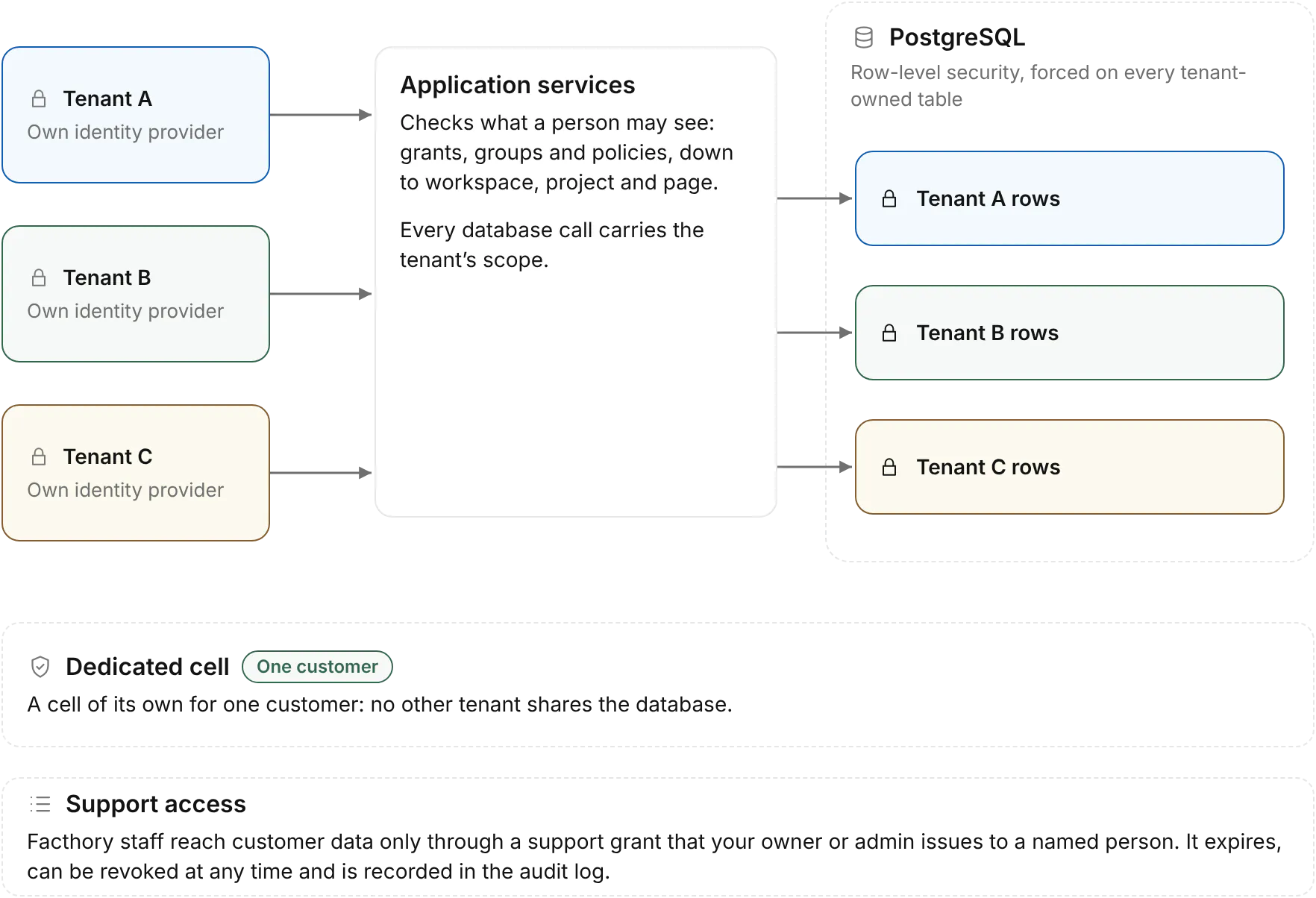
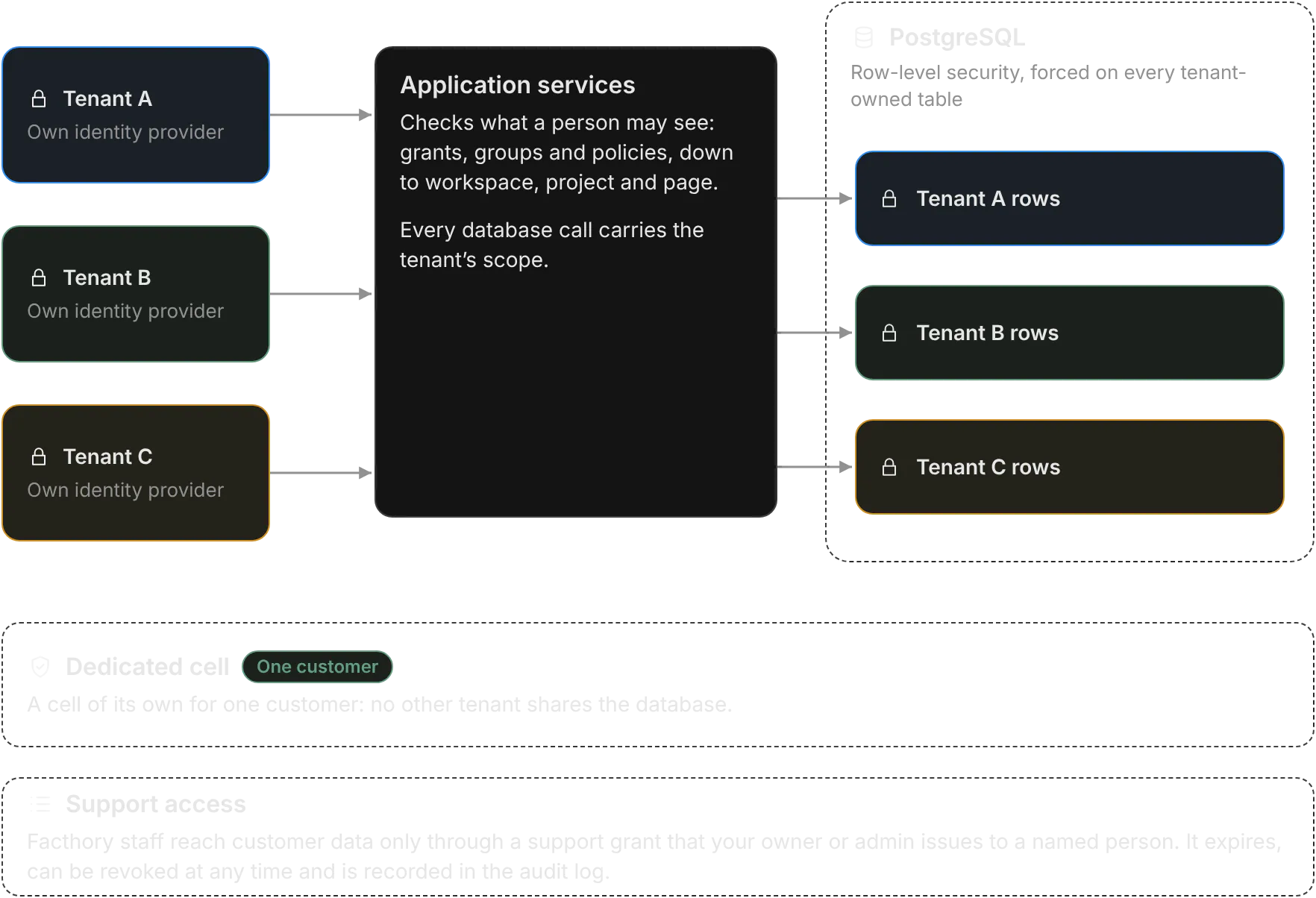
Data access. Relationship-based permissions (grants and groups) and policies decide who sees what, down to the workspace, the project and the page. An organisation sets its own classification levels, labels and clearances. Facthory staff reach customer data only through a support grant that the customer's owner or admin issues to a named person; the grant expires, can be revoked at any time and is recorded in the audit log.
Separation. Tenants are separated by forced row-level security on every tenant-owned table in PostgreSQL, and the database access in the code always carries the tenant's scope. Dedicated cells give a customer a cell of its own. Monitoring runs inside the cell's own Google Cloud project, isolated from other systems.
Pseudonymisation and minimisation. Audit events carry ids, codes and counts, never content. Problem reports leave the cell masked: emails, tokens, IP addresses, quoted titles and file names, and long digit runs are replaced, and URLs lose their query. Issues that are opened from errors carry masked messages only.
Encryption at rest. Customer-managed encryption keys in Google Cloud KMS protect the data, with the key ring in europe-west1. The database, the object storage and the cluster's secrets each have a separate key, and each key is rotated every 90 days. The storage bucket is private, with public access prevention enforced and uniform access.
Integrity
- Transfer control. The cell's load balancer uses Google's SSL policy MODERN with TLS 1.2 as the minimum. Current browsers and apps negotiate TLS 1.3, and no connection runs below TLS 1.2. The database takes encrypted connections only. Models are reached only through Facthory's model gateway.
- Input control. The agent asks for approval before it writes or sends: the session's writing mode sets this. Page version history shows what changed. The audit log records who read or changed what, as typed events with ids, codes and counts. Each tenant's events are numbered without gaps, and the log is append-only: the application cannot change or delete events. Events are kept for at least 90 days, and longer where the organisation's rule says so.
Availability and resilience
- Backups. The database is backed up daily at 02:00 UTC in europe-west1, and 30 daily backups are kept. Point-in-time recovery covers 7 days of transaction logs. Stored files are versioned: a replaced or deleted file stays recoverable for 30 days, then 7 more days in Google's soft delete. Deletion protection is on for the database and the cluster.
- Monitoring. Error alerts and the watch after every deployment run inside the cell's own Google Cloud project, isolated from other systems.
- Recovery time. After an incident, recovery takes at the latest 24 hours.
Regular review
- Privacy by default (Art. 25 GDPR). FACTHORY collects the data its features need. Audit events hold ids, not content, and the organisation's retention rules run every day.
- Training. The staff who work with personal data are trained in data protection and bound to confidentiality.
- Incident process. Automated alerting, notification immediately and within 24 hours at the latest, as set out in § 8.
- Subprocessor selection. Bandpey selects subprocessors for their security and data protection commitments, reviews their terms and certifications, and announces changes under § 6.
- Annual review. Bandpey reviews these measures at least once a year, and again when the processing changes materially.
Questions about data processing
The data protection contact answers questions about this agreement, the measures and the subprocessors.