



EU AI Act
The EU AI Act and where Facthory stands
Regulation (EU) 2024/1689 sets the rules for AI in the European Union. This page explains its terms, when they apply and how Facthory complies. Each point names the article it rests on. It explains Facthory's position and is not legal advice.
The terms
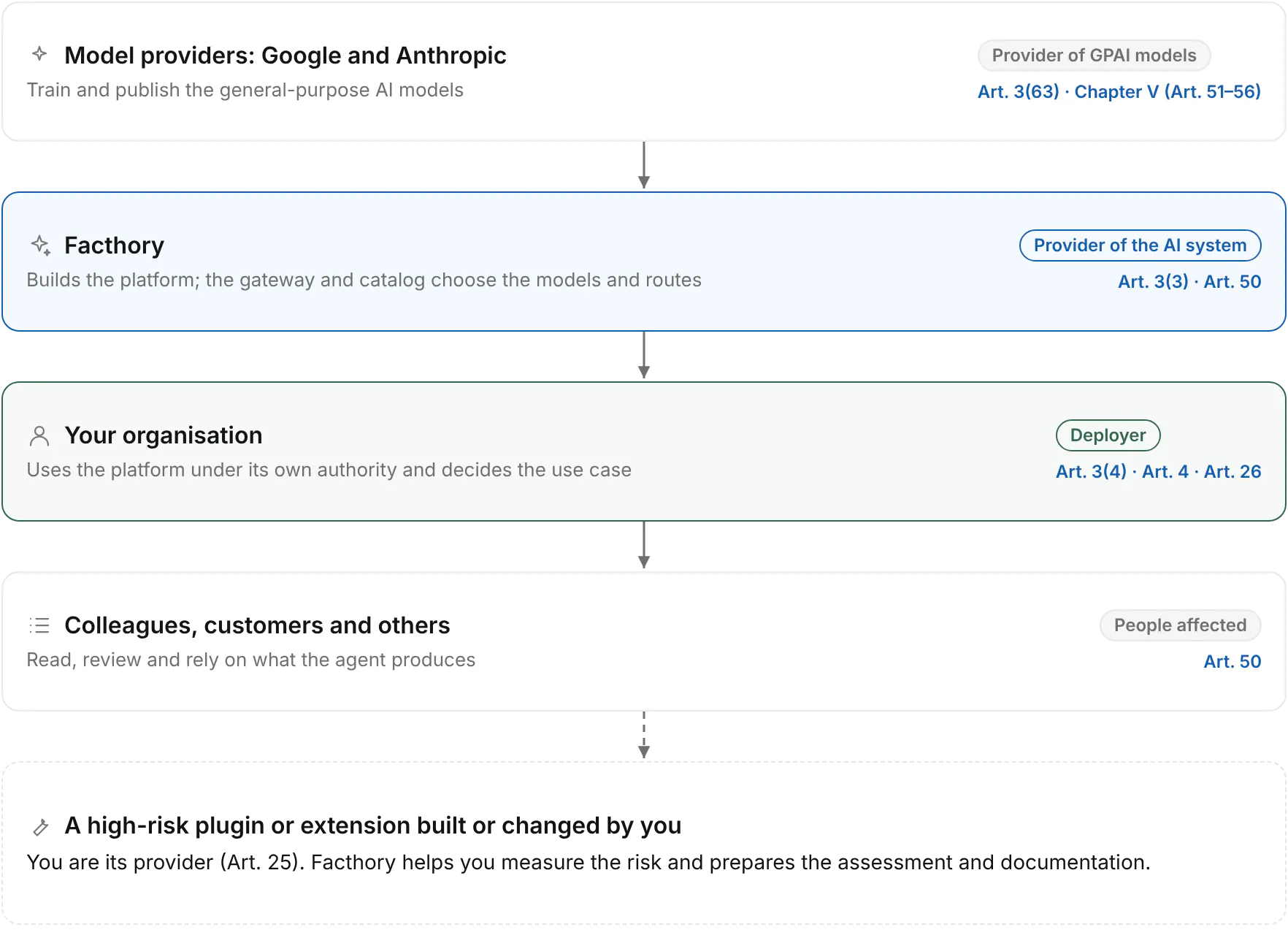
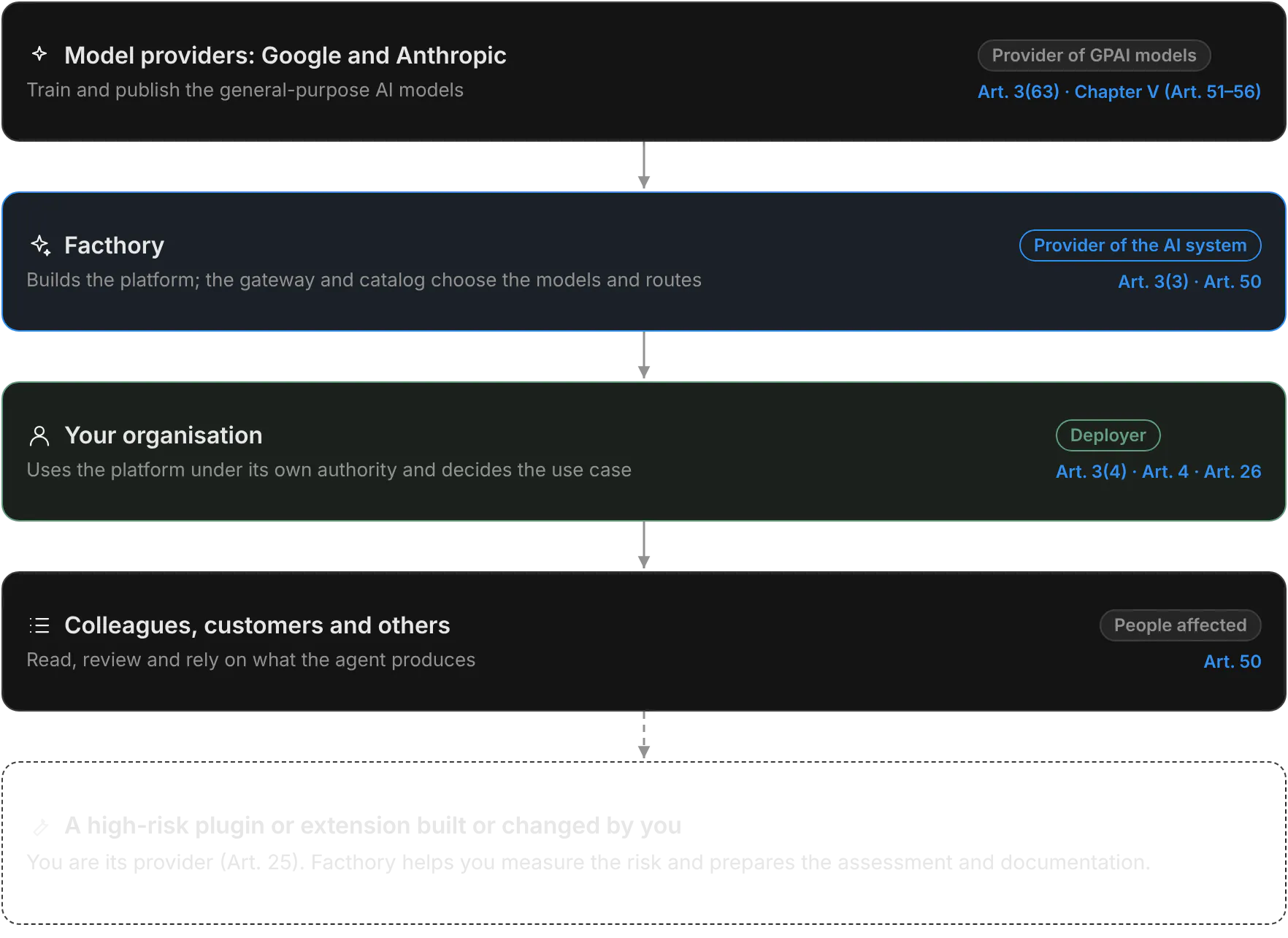
The Act uses a small set of defined roles and objects. Facthory's position follows from where each one sits.
| Term | What it means | Source |
|---|---|---|
| AI system | A machine-based system that operates with some autonomy and infers from its input how to produce outputs, such as content, predictions, recommendations or decisions. | Art. 3(1) |
| Provider | The person or organisation that develops an AI system or a general-purpose AI model, or has one developed, and places it on the market or puts it into service under its own name or trademark. | Art. 3(3) |
| Deployer | The person or organisation that uses an AI system under its own authority, except for personal, non-professional use. | Art. 3(4) |
| General-purpose AI (GPAI) model | An AI model trained on a large amount of data at scale that shows significant generality and can competently perform a wide range of tasks. It can be built into many downstream systems. | Art. 3(63) |
| GPAI system | An AI system based on a GPAI model that can serve a variety of purposes, both for direct use and for integration into other AI systems. | Art. 3(66) |
Source: Regulation (EU) 2024/1689, Article 3.
The timeline
| Date | What applies | Source |
|---|---|---|
| 1 August 2024 | The Regulation enters into force. | Art. 113 |
| 2 February 2025 | General provisions, including AI literacy, and the prohibited practices apply. | Art. 113(a), Art. 4, Art. 5 |
| 2 August 2025 | The rules for general-purpose AI models (Chapter V), governance and penalties apply. | Art. 113(b) |
| 2 August 2026 | The remaining rules apply, including the transparency duties. Marking of synthetic content under Art. 50(2) applies from 2 December 2026 to systems placed on the market before this date. | Art. 113, Art. 50, Regulation (EU) 2026/1744 |
| 2 December 2027 | High-risk systems of Annex III apply. | Art. 6(2), Regulation (EU) 2026/1744 |
| 2 August 2028 | High-risk systems that are safety components of products under Annex I apply. | Art. 6(1), Regulation (EU) 2026/1744 |
Regulation (EU) 2026/1744, the Digital Omnibus on AI, amends the dates for high-risk systems and the marking duty. Source: Regulation (EU) 2024/1689, Article 113, as amended.
Prohibited practices (Article 5)
Article 5 bans AI practices that the Union considers unacceptable. They include:
- manipulating people with subliminal or deceptive techniques that cause harm;
- exploiting vulnerabilities due to age, disability or social or economic situation;
- social scoring that leads to unjustified or disproportionate treatment;
- predicting that a person will commit a crime based only on profiling;
- scraping facial images from the internet or CCTV to build recognition databases;
- inferring emotions in the workplace and in education, except for medical or safety reasons;
- categorising people biometrically to infer sensitive traits;
- real-time remote biometric identification in public spaces for law enforcement, with narrow exceptions.
Facthory's position. Facthory works on your organisation's own work content: documentation, knowledge, analytics and agents that act on them. None of the banned practices is part of the platform or of any use case Facthory offers.
Source: Regulation (EU) 2024/1689, Art. 5.
High-risk classification (Article 6, Annex III)
A system is high-risk in two ways. It is a safety component of a product covered by the Union legislation in Annex I, or it is used in one of the areas listed in Annex III: biometrics, critical infrastructure, education and vocational training, employment and workers management, access to essential services, law enforcement, migration and border control, and the administration of justice and democratic processes. A system in an Annex III area can fall outside the class when it performs only a narrow procedural task or a preparatory task and does not profile people, among other conditions that Art. 6(3) sets out.
Facthory's position. Knowledge work, documentation and analytics are not Annex III uses. Facthory's own use cases sit outside the high-risk class. A use case that you add can change that. An agent that evaluates employees or allocates work between them falls under Annex III, point 4, and the responsibility for that use case is yours. Facthory helps you measure the risk.
Source: Regulation (EU) 2024/1689, Art. 6, Annex I and Annex III.
Responsibilities along the value chain (Article 25)
The Act spreads duties along the chain from model to user. Anyone who puts their name on a high-risk system, changes it substantially, or changes the intended purpose of a system so that it becomes high-risk becomes its provider (Art. 25(1)). The previous provider cooperates and supplies the information needed (Art. 25(2)). A provider and a third party that supplies tools, services or components for a high-risk system agree in writing which information and support the third party delivers (Art. 25(4)).
Facthory's position. The models come from Google and Anthropic, who are providers of general-purpose AI models. Facthory is the provider of the platform as an AI system. You are the deployer. For a high-risk plugin or extension that you build or change, you are the provider. Facthory helps you measure the risk and prepares the risk assessment and the documentation for further use cases, plugins and extensions.
Source: Regulation (EU) 2024/1689, Art. 25.
Deployers' duties (Article 26)
For high-risk systems the deployer uses the system according to its instructions, assigns human oversight to people with the competence, authority and support to exercise it, makes sure the input data is relevant for the intended purpose, monitors the operation, keeps the logs the system generates for at least six months, and informs workers' representatives and affected workers before putting a high-risk system to use in the workplace (Art. 26(1), (2), (4), (5), (6) and (7)).
Facthory's position. The platform keeps audit logs of what happens, and the agent asks for approval before it writes. These controls give a deployer the records and the oversight that Art. 26 asks for. For use cases outside Annex III these duties do not arise, and the controls still apply.
Source: Regulation (EU) 2024/1689, Art. 26.
Transparency (Article 50)
Article 50 asks providers to make sure that people know when they interact with an AI system, and to mark AI-generated audio, image, video and text in a machine-readable way (Art. 50(1) and (2)). Deployers disclose deepfakes and AI-generated text published to inform the public, unless a person has reviewed and taken editorial responsibility for it (Art. 50(4)).
Facthory's position. Content that the AI writes carries the label "Written by AI", so readers always know where a text comes from.
Source: Regulation (EU) 2024/1689, Art. 50.
General-purpose AI obligations (Chapter V)
Chapter V (Art. 51 to 56) puts duties on the providers of GPAI models: technical documentation, information for downstream providers, a copyright policy and a summary of the training content (Art. 53), and, for models with systemic risk, evaluation, risk mitigation, incident reporting and cybersecurity (Art. 55). Codes of practice help providers show compliance (Art. 56).
Facthory's position. Facthory is not a provider of general-purpose AI models. The models come from Google and Anthropic, and their providers carry the Chapter V obligations. Facthory chooses the models of the catalog and sets the routes in the model gateway.
Source: Regulation (EU) 2024/1689, Art. 51 to 56.
AI literacy (Article 4)
Providers and deployers promote AI literacy among their staff and the other people who operate AI systems on their behalf, in proportion to their technical knowledge, experience, education and the context of use.
Facthory's position. Facthory helps its clients build that literacy. The platform's learning features, courses and lessons, serve for it.
Source: Regulation (EU) 2024/1689, Art. 4.
How Facthory controls model behaviour
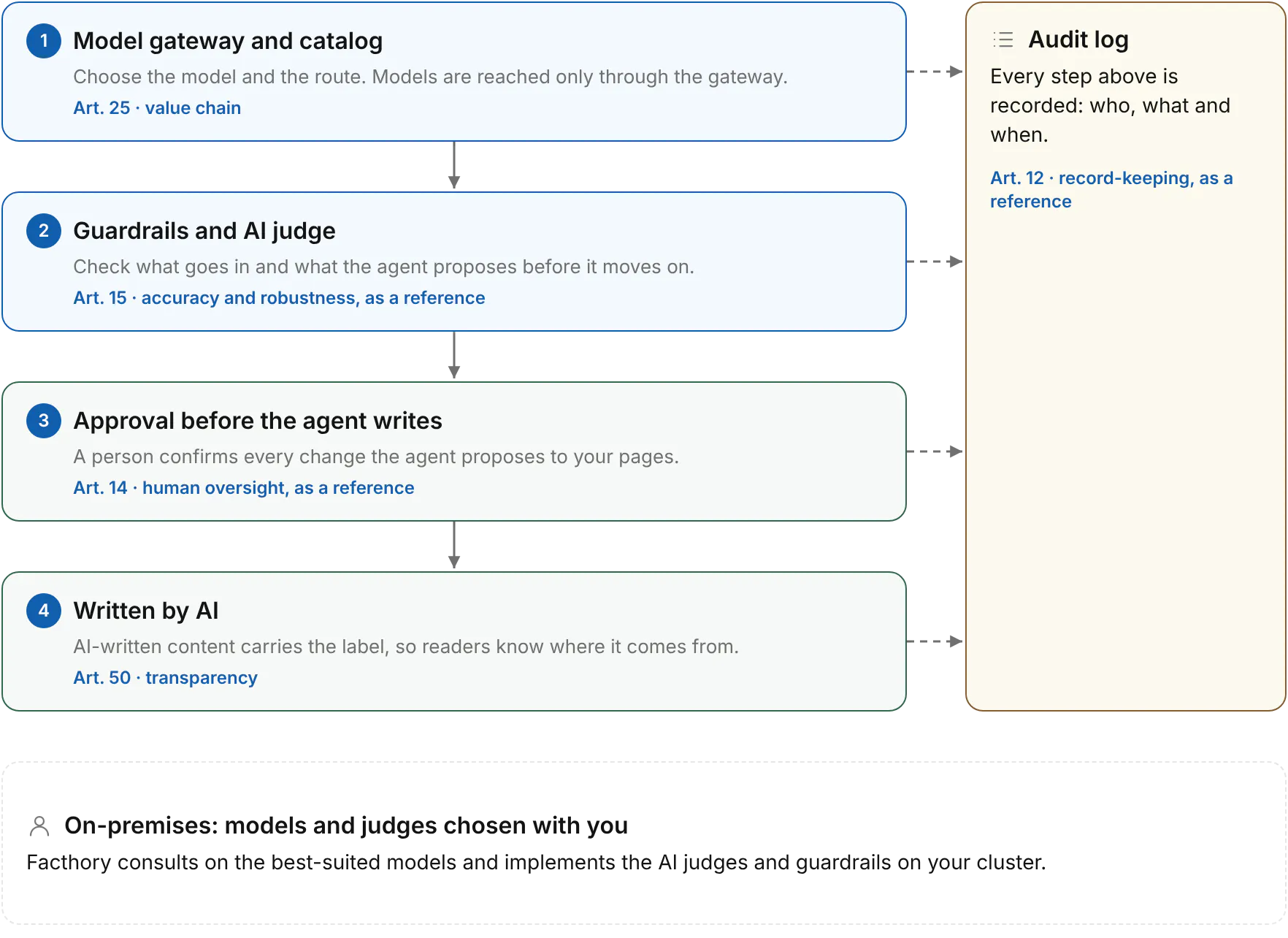
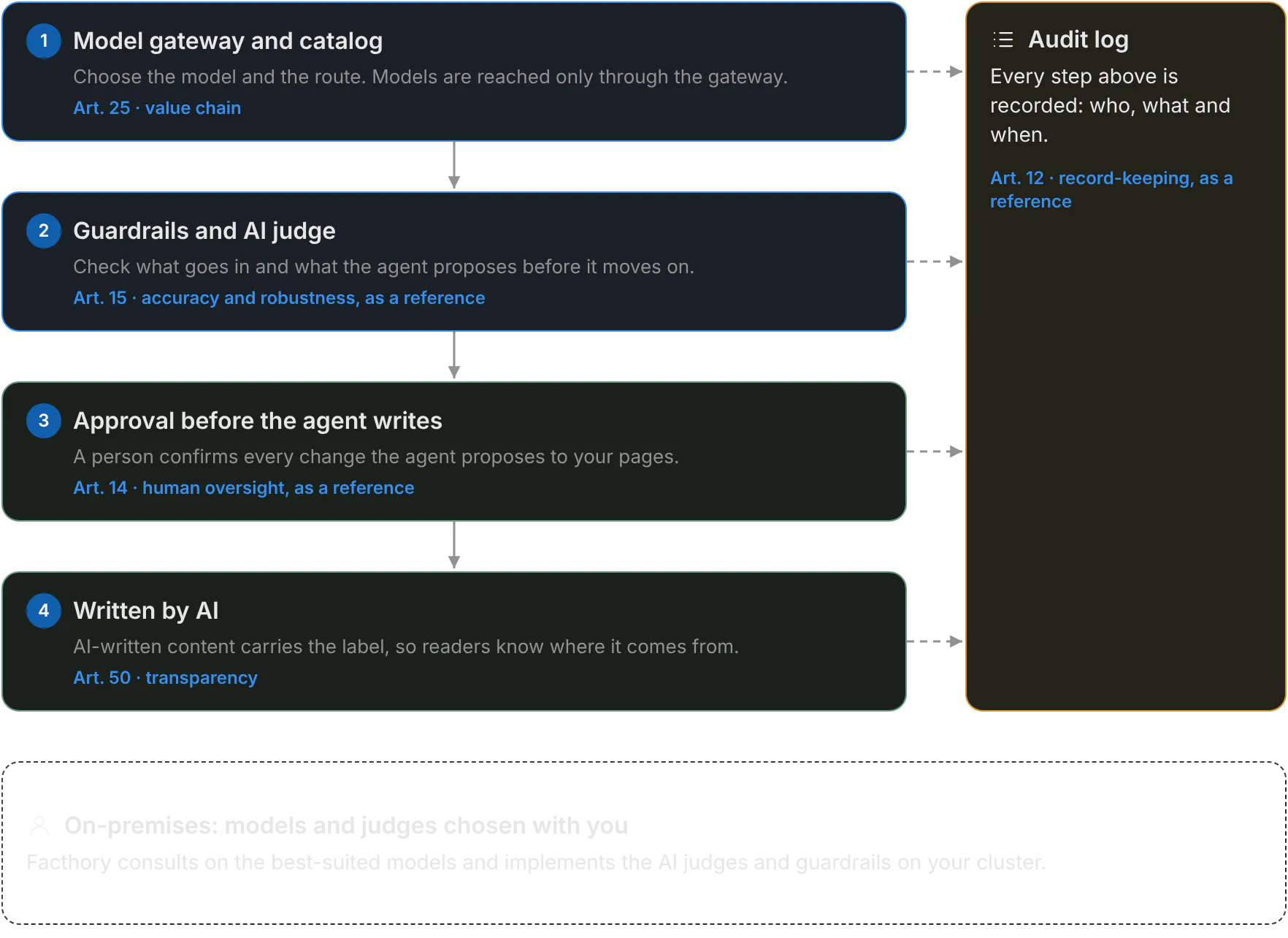
Facthory controls model behaviour at every step, so you do not have to rely on the model alone.
- Model gateway and catalog. They choose the models and the routes. Models are reached only through the gateway.
- Guardrails and an AI judge. They check what goes in and what the agent proposes.
- Approval before the agent writes. A person confirms each change the agent proposes.
- Audit log. The platform records what happens.
- "Written by AI". AI-written content carries the label.
On-premises, Facthory consults you on the best-suited models and implements the AI judges and guardrails on your cluster.
Go deeper
Where the controls live, and where the platform runs.
Bring a use case, and we measure the risk with you
Plugins, extensions and new use cases: Facthory helps you assess the risk and prepares the documentation.